
Other Resources
There is an active Hanns Heinz Ewers group on Facebook. Feel free to check it out and join the fun!
I also have a Hanns Heinz Ewers blog where I post new material pertaining to Hanns Heinz Ewers. Be sure to subscribe so you don’t miss new products or information. And lastly I do a weekly podcast of short stories by various authors that I’ve translated including Hanns Heinz Ewers , Karl Hans Strobl and others from the pages of Der Orchideengarten and Kokain with more on the way.
About Hanns Heinz Ewers
Hanns Heinz Ewers was born in Düsseldorf Germany on 3 November 1871.
Both of his parents were artists. His father was a painter and a singer. His mother was a painter and a gifted storyteller. He, himself, was a writer, poet, playwright, filmmaker and comedian. His film, The Student of Prague, was the first film ever to make use of a double. His most famous novel, Alraune, has been translated into twenty languages and made into a film five times. He is mostly known as a horror writer in the tradition of Edgar Allan Poe.
Why then have most people not heard of him?
The easy answer is that he was a strong supporter of German nationalism during the Second World War even though he was also a strong supporter of the Jewish cause as well. In the end Ewers books were banned in Nazi Germany and he died in 1943 persona non grata in poverty. After the war his Nazi affiliation caused his literary works to be shunned and he has been largely forgotten.
This is the easy answer. The harder and more accurate answer is very complex because he was a very complex person. As I translate more of his material I will try to find more answers to the life of this very interesting person as well.
“Books by Hanns Heinz Ewers.”
— Joe E Bandel
Our commitment
I use both Lulu publishing and Kindle books for my products and services to ensure quality and reasonable prices. I uphold a standard of excellence that is unwavering. Here you will find links to hardcover, paperback and PDF or Epub or Kindle editions of these books. I remain steadfast in my dedication to our core principles, which serve as the foundation of our identity.
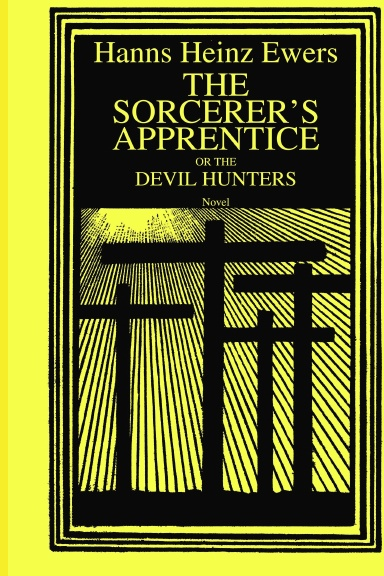
The First Volume in the Frank Braun trilogy. This is the first uncensored English translation of “The Sorcerer’s Apprentice”. It includes an Introduction by Dr. Wifried Kugel; the poems, “Prometheus” by Goethe,and “Hymn to Satan” by Carducci; “The Satanism of Hanns Heinz Ewers”, “Duality-The Male”, “Duality-The Female”,and “Duality-Sexual Alchemy” by Joe Bandel and the complete text of “Synagogue of Satan” by Stansislaw Przybyszewski also translated by Joe Bandel. Art is by Mahlon Blaine.
In this book we meet Frank Braun for the first time. He intends to start a religious cult in the sleepy mountain village of Val di Scodra. To do this he uses hypnosis and his understanding of mystical states to manipulate and control the situation but it soon gets out of hand when a young girl from the village is recognized as a spiritual leader. . .
For several years after writing “The Sorcerer’s Apprentice” Hanns Heinz Ewers gave highly successful lectures on “The Religion of Satan” which were based upon “The Synagogue of Satan”. His view of “Satanism” is highly different than what is popular today and shows that his belief in the future of humanity lies in the balancing of the male/female aspects within us and not in two eternal forces in opposition, good/evil. For him Satanism was the emancipation of women.
This book is available in hardcover, paperback and PDF versions from Lulu publishing. Kindle edition is available here.
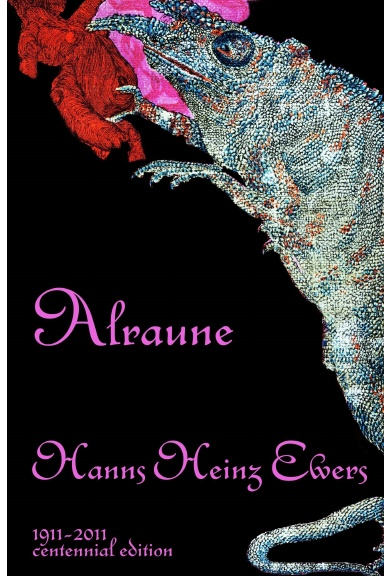
Alraune by Hanns Heinz Ewers is available as a hardcover , paperback from Lulu publishing and Kindle from Amazon. Hanns Heinz Ewers horror classic novel now uncensored for the first time
in the English language. Includes essays by Dr. Wilfried Kugel, Tyler
Davis and Joe Bandel plus original artwork by Mahlon Blaine and
illustrations by Ilna Ewers-Wunderwald for the 1911 edition of Alraune. Alraune has been made into a movie five times and translated into over ten languages. The existing English translation was badly censored. This is a completely new and uncensored translation by Joe E Bandel.
It is the second book in the Frank Braun trillogy. Frank Braun talks his uncle into creating a human mandrake by artificially inseminating a prostitute with the semen of an executed murderer. This is the story of that child and how all those who knew her loved her but met with strange fates.

The long awaited sequel to the “Frank Braun trilogy”. “Vampire” is the final book of the series written by German author Hanns Heinz Ewers, in an uncensored translation for the first time by Joe Bandel. The first two books in the series are “Sorcerer’s Apprentice” and “Alraune”, also translated by Joe Bandel. The previous English language translation of this book was heavily censored and missing around 150 pages! It was also banned in the United States and allied countries presumably because it spoke of the “Steigler Afair” named after then Secretary of State Steigler before the United States officially entered World War I.
In the book Ewers speaks of hundreds if not thousands of German Americans including Jewish Americans that wanted to go to the “Fatherland” and help Kaiser Wilhelm fight the war. They bought passage on steamers headed for Germany and were instead sent directly to prisoner of war camps in France and England. This was before the United States officially entered the war.
This book is largely biographical and speaks of Frank Braun being trapped here in the United states because of the war raging in Europe. He reconnects with an old flame, Lotte Lewi, who is now a rich widow and begins to work as a German propagandist for the German cause in an effort to keep the United States out of the war in Europe. But he experiences strange attacks of weakness that leave him helpless. It slowly comes out that something is taking all his energy, but is Lotte the vampire or is it him!
This book is available from Lulu publishing as a hardcover, paperback and as a Kindle ebook.
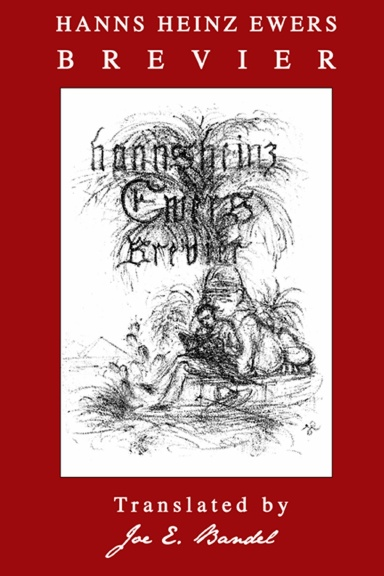
“Hanns Heinz Ewers Brevier” was first published in 1922 in the German language as a sampler of Ewers thoughts, ideas and beliefs. It is a collection of excerpts taken from a wide variety of his writing and organized into the categories, Music, Art and the Artist,Love, Philosophical Observations, Religion, Peoples and Lands, Politics and Love of the Fatherland and a final section entitled In Person.
This small book gives important insight into the thoughts and beliefs of this very important and forgotten author. It has been translated into English for the first time by Joe E. Bandel. The contents of this brevier were selected by people that knew Hanns Heinz Ewers very well and were quite close to him. It is a very important book in terms of how his closest friends and associates saw him.
This is available from Lulu publishing as a Hardcover and epub version.
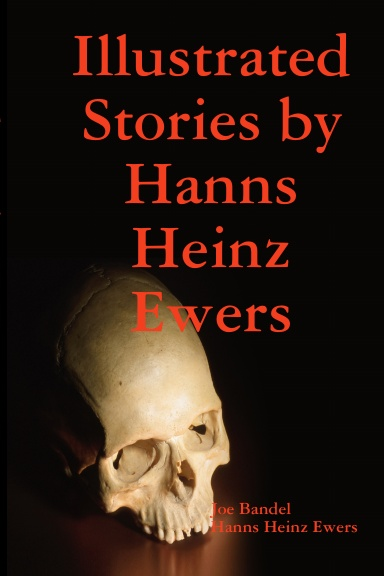
Collectible hard bound book with dust cover. Collects the three illustrated stories by Hanns Heinz Ewers, “The Hearts Of Kings”,”The Sad Story Of My Drying Out” and “Edgar Allan Poe”. The “Hearts Of Kings” has the original illustrations from the 1922 edition by Stefan Eggeler. “The Sad Story Of My Drying Out” is illustrated by Oscar Berger and “Edgar Allan Poe” has the original illustrations as well and includes Adele Lewisohn’s intro to her own translation as well as the poem “Sphinx”. These stories and essays have been newly translated by Joe Bandel. Availabe as a hardcover and PDF ebook.

Short Stories and essays by Hanns Heinz Ewers and now translated by Joe E Bandel. Stories include: The Spider, The Crucified Clown, Delphi, The Curve, My Burial, Anthropoovaropartus, The Death of Baron Jesus Maria von Friedel, The Button Collection, Bible Billy, The Blue Indians,My Mother the Witch, Sibylla Madruzzo, Intoxication and Art and Edgar Allan Poe.
This book is available as a hardcover, paperback and Kindle editions.

This is the second volume in a collection of short stories by Hanns Heinz Ewers and translated by Joe E. Bandel and includes: “The White Maiden”, “Eleven Thousand Virgins and the Four Holy Three KIngs”,”The Water Corpse”, “Carnival in Cadiz”, “How Eleven Chinese Devoured Their Bride”, “From the Journal of an Orange Tree”,”Of Geese, Spirits, Leeches and the Cat Organ”,”Fairyland”,”Alraune and her Chauffeur”, “The Last Will and Testament of Stanislawa d’Asp”, “Mamaloi”,”The Worst Betrayal”, “The Lost Monkey”, plus a short introduction by Joe E. Bandel. This book is available as a hardcover, paperback and as a Kindle edition.
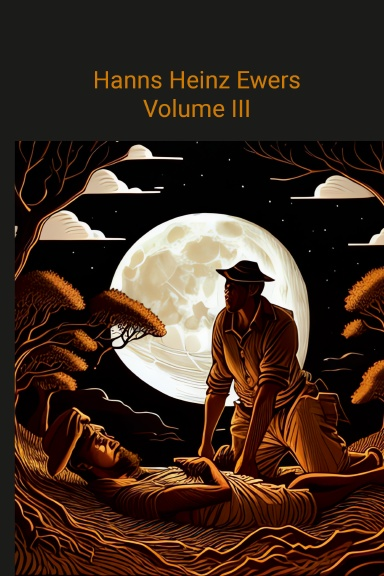
Hanns Heinz Ewers Volume III continues the incredible journey of discovery of this all but forgotten author of horror and dark fantasy.
Several of the stories in this selection really stir the emotions. “The Petersen Case” touches upon child abuse. “Tomato Sauce” is almost sickening in its portrayal of blood sports. But there is incredible beauty and sensitivity as well in “I Ride In The Rain”, a simple story with a beautiful message. “The Highest Love” challenges us in a totally different way by suggesting the power of love and sacrifice.
All of these stories have things to share and emotions to stir deep inside of us and they touch us as only Hanns Heinz Ewers can touch us. Enjoy!
The Execution of Damiens, Typhoid Mary, Trecento, Eileen Carter, I Ride In The Rain, Tomato Sauce, Gentlemen of the Bar, John Hamilton Llewellyn’s End, The Dead Jude, The Tophar Bride, The Petersen Case, The Highest Love, The Jews of Jeb.
This book is available as a hardcover, paperback and Epub edition.

This powerful and moving biography of Hanns Heinz Ewers was published in 1922 while he was still alive and presumably with his consent and blessing. It is written by someone who knows him well and is able to tell us more about the author than simple names, dates and places.
This beautiful book fully complements another book called the Hanns Heinz Ewers Brevier and gives additional insight into what this author was really like. Translated into the English for the first time by Joe E. Bandel. Now Available as a hardcover, paperback and Epub.

Gwinnie, Gwinnie Briscoe: she was the whole point of this! Andrea would get plenty more letters from her, far more than she’d like—dozens, hundreds. One last drawer—there lay two letters, set apart, from her cousin Jan Olieslagers. She checked the dates: one, from Bermuda, was a year old, the other three years already—from Peking. She picked them up, tore them halfway—then her hand stopped; absently, she slipped the letters into her handbag.
She passed the mirror, glanced at it instinctively, turned away quickly. No, no, she didn’t want to know how she looked now. Just this morning, she had stood here, a good hour, carefully preparing herself, with every art, for Parker Briscoe’s visit. But mirrors—mirrors were everywhere: in the hotel, she could stare at herself for hours, if she wanted to bid farewell to Andrea Woyland, to—herself.

 Bandel Books Online